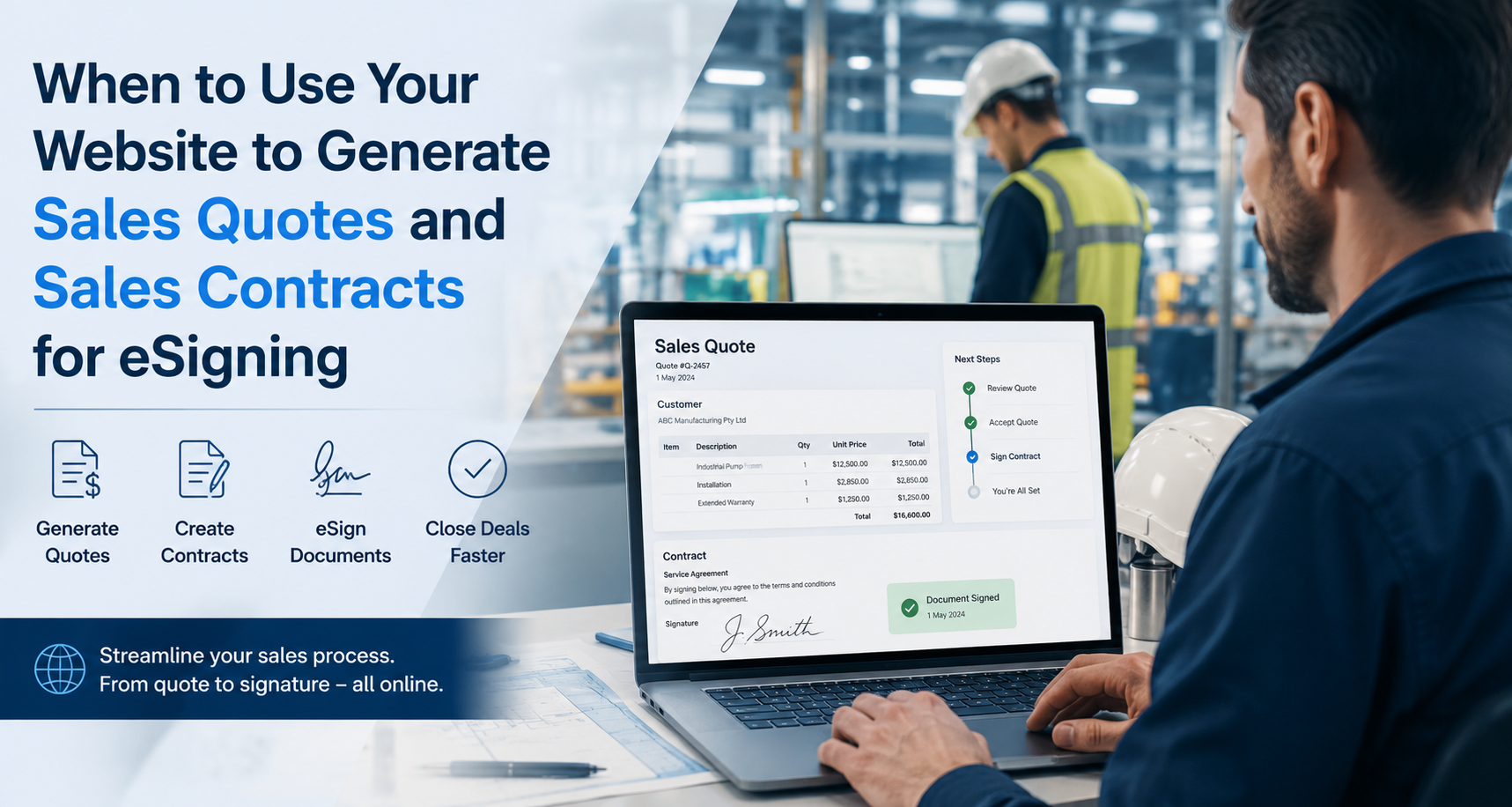
When to Use Your Website to Generate Sales Quotes and Sales Contracts for eSigning
Websites are no longer just digital brochures. Modern businesses increasingly use their websites as active sales platforms that generate quotes, contracts, approvals and customer onboarding workflows automatically.
Instead of relying on manual emails, Word documents and disconnected approval processes, businesses can now integrate quoting and contract generation directly into the customer journey. This creates faster response times, smoother sales workflows and a far more professional customer experience.
For many organisations, the website has effectively become the front-end interface for a much larger digital sales and operational ecosystem powered by custom software development services and integrated workflow automation platforms.
The Traditional Sales Process Creates Friction
In many businesses, the sales process still relies heavily on manual administration. A customer submits an enquiry form, waits for a response, receives a manually prepared PDF quote and then exchanges multiple emails before eventually signing a contract.
While this process may work for smaller businesses or low enquiry volumes, it often becomes inefficient as organisations grow. Delays between enquiry, quoting and contract approval can slow momentum and create unnecessary friction during the buying process.
Customers increasingly expect faster, more digital experiences. They are already comfortable booking travel, signing finance documents and purchasing complex services online. Business buying behaviour is evolving in the same direction.
When Website-Generated Quotes Make Sense
Website-generated sales quotes are particularly valuable when products or services follow structured pricing models or configurable workflows.
This commonly applies to industries such as manufacturing, equipment sales, software services, consulting, travel, construction services, managed IT services and subscription-based businesses.
Rather than waiting for a sales representative to manually prepare every document, customers can configure products, select options or request services directly through the website. The system can then generate branded pricing documents automatically based on predefined pricing rules and workflows.
Businesses implementing sales quoting software are increasingly using their websites to shorten response times and improve conversion rates by engaging customers while buying intent is still high.
Why Website Integration Improves the Customer Experience
One of the biggest advantages of integrating quoting and contract workflows into a website is consistency.
Customers no longer feel like they are moving between disconnected systems, documents and communication channels. Instead, the experience feels continuous from initial enquiry through to approval and onboarding.
A customer may configure products online, receive a personalised proposal instantly, review pricing interactively, approve the document digitally and sign the contract electronically — all within a single streamlined workflow.
Businesses using sales proposal software can create far more engaging buying experiences compared with traditional static PDF documents and manual approval processes.
Automating Sales Contracts and eSigning Workflows
Website-generated workflows become even more powerful when combined with automated contract generation and eSigning.
Once a customer accepts a proposal or selects a configuration, the system can automatically generate service agreements, rental contracts, onboarding forms, compliance documentation, finance agreements or subscription contracts.
These documents can then be presented for immediate digital approval and electronic signature.
Businesses using sales contracts and eSignature software often reduce approval delays significantly because customers can complete the process immediately rather than printing, scanning or manually emailing documents back and forth.
Complex Workflows Can Still Be Automated
Website-driven sales automation is not limited to simple ecommerce transactions. Many businesses now integrate highly customised quoting and approval logic directly into their digital platforms.
For example, a manufacturing business may allow customers to configure equipment options and automatically generate structured proposals with pricing, freight calculations and installation services included.
A consulting business may generate service agreements based on project scope selections. A travel company may automatically generate itineraries, travel contracts and approval documents based on booking data flowing from external systems.
Modern bespoke business software development allows businesses to connect websites, CRM systems, ERP platforms and document automation tools into highly streamlined operational workflows.
Why CPQ and Website Integration Are Becoming More Important
As product and pricing structures become more complex, businesses increasingly require CPQ (Configure, Price, Quote) capabilities integrated into their customer experience.
Instead of manually configuring products and pricing internally, CPQ workflows can guide customers through selections while automatically applying pricing rules, optional upgrades, taxes, finance calculations and approval logic.
Businesses implementing CPQ software implementation services are often able to reduce quoting errors while improving consistency across sales teams and customer-facing workflows.
This becomes particularly valuable in industries where pricing complexity would otherwise require extensive manual administration.
Websites Are Becoming Operational Platforms
Many businesses still think of websites primarily as marketing tools. Increasingly, however, websites are evolving into operational business platforms connected directly to internal systems and customer workflows.
A modern website may integrate with CRM platforms, quoting systems, ERP software, payment gateways, inventory systems, eSignature workflows, customer onboarding tools and finance systems.
This creates a far more scalable operational model because information flows automatically between systems instead of relying on repetitive manual handling.
Businesses investing in website development and software integration services are increasingly focused on eliminating operational friction and improving digital customer experiences simultaneously.
Reducing Administrative Overhead
One of the biggest operational advantages of automated quoting and contract workflows is the reduction in manual administration.
Sales teams spend less time preparing repetitive documents and more time focusing on customer engagement and higher-value sales activities.
Document automation also reduces pricing inconsistencies, formatting errors, approval delays and version control issues that commonly occur with manually managed documents.
Businesses using interactive proposal software are often able to improve both operational efficiency and customer response times at the same time.
The Buying Experience Matters More Than Ever
Customers increasingly judge businesses not only by products and pricing, but by how easy the buying experience feels.
Slow proposal turnaround, disconnected approval processes and manual paperwork create friction that can weaken customer confidence.
In contrast, streamlined digital workflows create the impression of operational maturity, responsiveness and professionalism.
Businesses investing in web development and ecommerce solutions are increasingly using customer experience itself as a competitive advantage.
Final Thoughts
Websites are rapidly evolving beyond static marketing platforms. They are becoming intelligent business systems capable of generating quotes, contracts, approvals and onboarding workflows automatically.
Businesses integrating sales quote software and eSignature workflows directly into their websites can reduce administrative overhead, accelerate approvals and create significantly better customer buying experiences.
Combined with software development services , modern digital quoting workflows are helping businesses create more scalable and operationally efficient sales processes across a wide range of industries.