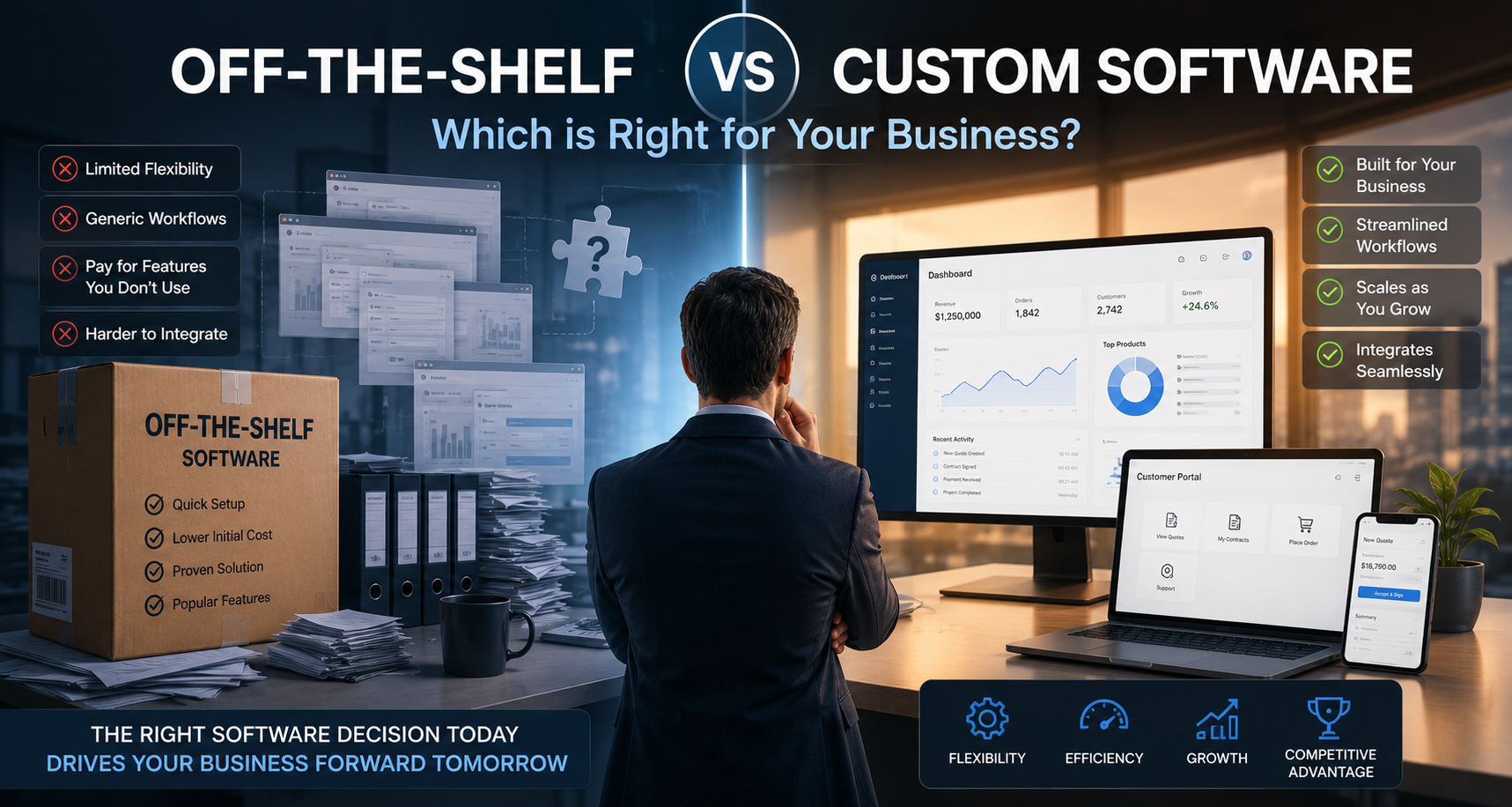
Off-the-Shelf vs Custom Software: Which is Right for Your Business?
Almost every growing business eventually reaches the same decision point: should you buy existing software, or build something tailored specifically to your business?
Off-the-shelf software can often provide a fast and cost-effective starting point. Custom software, on the other hand, offers flexibility, operational alignment and long-term scalability that packaged platforms sometimes struggle to achieve.
The right answer depends less on technology itself and more on how your business operates, how unique your workflows are and where you see the business evolving in the future.
For many organisations, the decision is not simply about features. It is about operational efficiency, customer experience, scalability and competitive advantage.
Why Off-the-Shelf Software Is So Popular
Off-the-shelf software exists for a reason. In many situations, it solves common business problems quickly and affordably without the need for lengthy development projects.
Platforms like accounting systems, CRM platforms, ecommerce solutions and project management tools allow businesses to implement mature functionality relatively quickly.
For startups and smaller organisations especially, this can be extremely valuable because it reduces upfront cost and allows teams to focus on growth rather than building technology from scratch.
Modern SaaS platforms have also improved dramatically over the past decade. Many now include strong APIs, automation capabilities and integration ecosystems that make them far more flexible than older software products.
The Hidden Trade-Offs of Standard Software
The challenge with off-the-shelf platforms is that they are designed to serve broad markets rather than the exact operational requirements of a specific business.
This often means businesses end up adjusting their workflows to fit the software rather than the software supporting the way the business naturally operates.
Initially this compromise may feel manageable. Over time, however, operational friction tends to increase as teams introduce spreadsheets, manual workarounds, disconnected systems and repetitive administration to compensate for software limitations.
Businesses frequently discover that what appeared inexpensive upfront can become operationally expensive later through inefficiency, integration complexity and lost productivity.
When Custom Software Starts Making Sense
Custom software becomes significantly more valuable when a business has workflows, processes or customer experiences that create competitive differentiation.
In these situations, forcing the business into generic software limitations can slow innovation and create operational bottlenecks.
Manufacturing businesses, logistics providers, travel companies, healthcare organisations, SaaS businesses and professional service firms often develop highly specialised operational processes over time. Standard software may handle parts of the workflow well, but struggle to manage the entire operational picture cohesively.
This is where bespoke business software development can become strategically valuable because systems are designed around the business itself rather than forcing the business into generic platform structures.
The Real Value of Custom Software Is Workflow Alignment
Many people assume custom software is primarily about creating unique features. In reality, the biggest value often comes from workflow alignment.
When systems align closely with how teams already work, businesses reduce friction significantly. Staff spend less time re-entering information, switching between disconnected systems or managing manual processes outside the platform.
Good custom software simplifies operations rather than adding technical complexity. The best implementations often feel invisible because the technology supports the workflow naturally instead of disrupting it.
This becomes particularly important when businesses rely heavily on customer-facing workflows such as quoting, onboarding, approvals, service delivery or ecommerce transactions.
Integration Complexity Often Changes the Equation
One of the biggest reasons businesses move toward custom software is integration complexity.
Modern organisations rarely operate using a single platform. Instead, they rely on multiple systems across sales, finance, operations, customer service, ecommerce and reporting.
Over time, businesses often discover that the real challenge is not individual software products themselves, but the gaps between them.
Businesses investing in software integration development services are increasingly focused on creating connected digital ecosystems where information flows automatically between platforms instead of relying on manual administration.
In many cases, custom software acts as the operational layer that ties multiple systems together cohesively.
Customer Experience Is Becoming a Major Driver
Customer expectations have changed significantly. Businesses are no longer competing only on products and pricing. They are competing on digital experience as well.
Generic software can sometimes make customer interactions feel fragmented or impersonal because businesses are constrained by standard workflows and interface limitations.
This is particularly noticeable in areas such as:
ecommerce, quoting, onboarding, approvals, bookings, self-service portals and customer communication workflows.
Businesses investing in website development and ecommerce solutions are increasingly using custom workflows to create smoother and more differentiated customer experiences.
Custom Software Does Not Mean Rebuilding Everything
One common misconception is that choosing custom software means replacing every system inside the business. In reality, modern software strategies are often hybrid approaches.
Businesses may continue using established SaaS platforms for accounting, CRM or communication while building custom operational layers around them.
This allows organisations to leverage the strengths of mature software platforms while still creating tailored workflows where competitive differentiation matters most.
For example, a business may integrate:
ecommerce systems, ERP platforms, CRM software, proposal systems, CPQ workflows and customer portals into a unified operational experience.
Scalability Is About More Than User Numbers
Businesses often think of scalability purely in technical terms. In practice, operational scalability matters just as much.
As businesses grow, inefficient workflows become increasingly expensive. Manual administration that feels manageable with five staff may become a major operational problem with fifty.
Custom software can help businesses scale operationally by automating repetitive processes, improving data flow and reducing dependency on manual handling.
This becomes especially valuable for businesses experiencing rapid growth or managing high transaction volumes.
The Right Choice Depends on Strategic Importance
Not every business problem requires custom software. In many cases, off-the-shelf platforms are absolutely the right decision.
The key question is whether the workflow or customer experience plays a meaningful role in how the business differentiates itself competitively.
If the software supports a commodity function that is relatively standard across industries, existing SaaS platforms may be entirely sufficient.
However, if operational efficiency, customer experience or workflow innovation directly affects competitive advantage, then custom software often becomes a strategic investment rather than simply a technology project.
Final Thoughts
The decision between off-the-shelf and custom software is rarely black and white. Most modern businesses ultimately operate somewhere in between.
Off-the-shelf software can provide speed, maturity and lower upfront cost. Custom software provides flexibility, workflow alignment and the ability to create operational experiences tailored specifically to the business.
Businesses investing in custom business software and digital workflow solutions are increasingly focused on creating scalable operational systems that improve efficiency, customer experience and long-term adaptability.